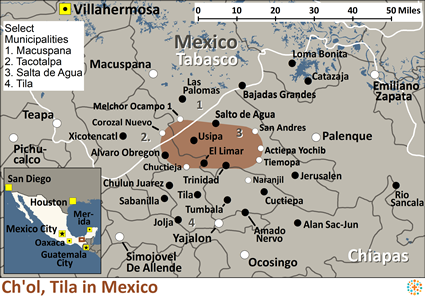

Nestled in the rugged northern highlands of Chiapas, the town of Tila gives its name to one of the most historically significant Ch'ol communities in southern Mexico. The Tila Ch'ol are Maya descendants whose ancestors populated this mountainous region long before Spanish forces arrived in the mid-sixteenth century. The town itself was formally established in 1564 by the Franciscan friar Pedro Lorenzo de la Nada, who oversaw the resettlement of dispersed Ch'ol groups into Spanish mission communities. Colonial rule brought forced labor on encomiendas and an unrelenting pressure on communal lands that would continue for centuries — through the Porfirian era, when foreign coffee and agro-export firms absorbed indigenous territory, and into the twentieth century, when land disputes between Ch'ol ejido holders and municipal authorities became a defining feature of Tila's social landscape. That struggle has never fully resolved: the Tila ejido community has fought prolonged legal battles to reclaim communal land stripped by local government since the 1960s, a conflict that touches the heart of Ch'ol identity, in which land, culture, and community governance are inseparable. The Tila Ch'ol speak Ch'ol, a Mayan language, in the Tila dialect — one of three mutually intelligible varieties of the language spoken across the northern Chiapas highlands.
Subsistence farming forms the backbone of daily existence. Milpa cultivation — the ancient Maya system of growing corn, beans, and squash together — remains the primary means of feeding families, supplemented by bananas, chili, and other garden crops. Coffee has long been a cash crop in Tila's surrounding valleys, and since the late nineteenth century it has tied Ch'ol farmers into regional and international markets, with mixed results for household income. Many families also raise pigs and poultry, selling livestock when cash is needed for medicine or other goods not grown at home.
The communal assembly is a cornerstone of Tila Ch'ol governance and social life. Decisions affecting the ejido — the communal landholding — are made collectively, and traditional authorities carry moral weight alongside (and sometimes in opposition to) elected municipal officials. This tension between customary governance and outside political structures has been a source of both resilience and conflict. Extended family networks provide social support across generations, with elder men and women carrying authority as knowledge holders and mediators.
Tila draws pilgrims from across Chiapas and beyond each January for the festival of the Señor de Tila, a gathering that transforms the town into one of the most active pilgrimage centers in southern Mexico. Carnaval, observed in the days before Ash Wednesday, involves ceremonial dances, the formal transfer of community cargo roles, and dramatic performances. The Day of the Dead brings families together at home altars laid with food and flowers for the returning spirits of the deceased. Oral tradition is a living art form: skilled storytellers who can hold an audience with sacred myths, creation narratives, and community histories are genuinely admired.
The Tila Ch'ol are almost entirely Christian in formal identification, the vast majority as Roman Catholics, with a meaningful evangelical Protestant minority. Yet the practice of faith in Tila is inseparable from an engagement with the pre-Columbian spirit world. The town's central religious focus — the Señor de Tila, a Black Christ venerated in a cave — illustrates this fusion with unusual clarity. The image is an anthropomorphic stalagmite, and its setting in a cave is not incidental: in traditional Maya cosmology, caves are the dwelling of the Earth Lord, the deity who governs the natural world and must be petitioned before its resources can be used. The Black Christ and this cave deity have been merged in the popular religious imagination, so that pilgrims approach the shrine carrying petitions that belong as much to the pre-Columbian spirit world as to Christian prayer. Local healers and ritual specialists move between churches and caves as a matter of course, drawing power from both. These practitioners do not place their ultimate trust in Jesus Christ as Lord and Savior; their faith is distributed across saints, ancestral forces, and cave deities whose authority is as real to them as any biblical promise. For much of the community, Christianity and traditional Maya spirituality are not in tension — they are simply two layers of a single religious world.
Chiapas consistently ranks among Mexico's most impoverished states, and the Tila region reflects that reality. Access to reliable medical care is limited; specialized treatment requires travel to distant urban centers, a hardship that discourages many from seeking help until conditions become serious. Waterborne illness is a persistent threat — access to clean, reliable water has even become a point of political contention, with outside authorities imposing water meters on springs that sit within communally held ejido land. Educational opportunity, particularly at the secondary and higher levels, remains out of reach for many young people, constrained by poverty, distance, and the pressure to contribute to household labor. Economic alternatives to subsistence farming and smallholder coffee production are scarce, limiting the capacity of families to weather crop failures or market fluctuations.
Pray that Tila Ch'ol evangelical believers would grow in bold, rooted faith and take the gospel — in their own language and from their own cultural experience — to unreached peoples throughout Mexico and Latin America.
Pray for the Lord to protect their community from local insurrections and rebel groups.
Pray for the Holy Spirit to open the eyes of the Tila Ch'ol to the true identity of Jesus Christ, drawing worshipers away from syncretic devotion to the Black Christ and into saving faith in the risen Lord.
Pray that Christian workers with medical and practical skills would come alongside Tila Ch'ol communities, bringing healing and hope while earning the trust needed to share the gospel.
Pray for Ch'ol church leaders to be equipped with sound biblical teaching so their congregations become disciple-making communities capable of sending workers to other unreached peoples.
Scripture Prayers for the Ch'ol, Tila in Mexico.
https://en.wikipedia.org/wiki/Tila,_Chiapas
https://en.wikipedia.org/wiki/Ch%CA%BCol_people
https://www.encyclopedia.com/humanities/encyclopedias-almanacs-transcripts-and-maps/chol
https://www.sipaz.org/in-focus-the-tila-ejido-an-example-of-struggle-for-land-and-territory/?lang=en
https://schoolsforchiapas.org/the-ejido-in-tila-and-the-chol-people-the-impossible-pursuit-of-a-legal-victory/
https://www.academia.edu/41944582/The_Black_Christ_of_Tila_Chiapas_The_History_of_a_Modern_Maya_Pilgrimage_Center_2003_
| Profile Source: Joshua Project |